
Rate this tool
No ratings yet — be the first to rate!
Total ratings: 0
Free EMI Calculator
A loan is decided twice: once when the bank approves it, and again every month when the EMI leaves your account. Knowing that monthly figure before you sign is what separates a comfortable loan from a strained one. This calculator turns three inputs, loan amount, interest rate and tenure, into the monthly EMI, total interest and total payable, with a principal-versus-interest split alongside. Use it to compare lender offers on equal terms, and to see what a longer tenure really costs.
I ran five loan scenarios through this calculator on the live site and checked every figure against an independent calculation of the same formula. All five matched to the rupee. The main test — Rs 5,00,000 at 10 percent for 5 years — is in the test section below.
How to compare loans with this EMI calculator
- Enter the amount you actually need, not the maximum the lender offers.
- Set the annual rate from the lender offer letter, not from an advertisement.
- Read all three results together: EMI, total interest and total payable. A low EMI alone is never the full story.
- Shorten the tenure step by step. The EMI rises, but total interest falls sharply.
- Compare lenders by entering each offer separately and noting total payable.
The EMI formula
EMI = P x r x (1 + r)n / ((1 + r)n - 1), where P is principal, r is the monthly rate (annual rate divided by 12 and by 100), and n is the number of monthly payments.
Tested: a Rs 5,00,000 loan at 10% for 5 years, checked to the rupee
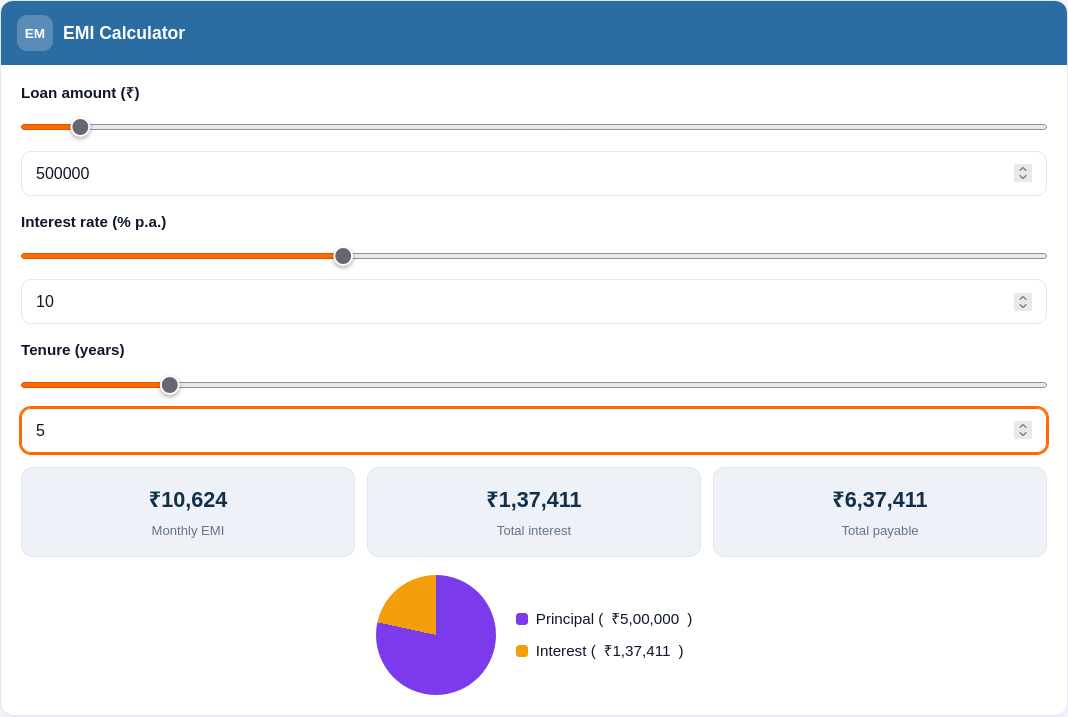
I entered Rs 5,00,000, an annual rate of 10 and a tenure of 5 years. The calculator showed Monthly EMI Rs 10,624, Total interest Rs 1,37,411 and Total payable Rs 6,37,411, with the donut splitting principal Rs 5,00,000 against interest Rs 1,37,411.
Checked separately: r = 10 ÷ 12 ÷ 100 = 0.008333, n = 60, (1 + r)n = 1.645309, so EMI = 5,00,000 × 0.008333 × 1.645309 ÷ 0.645309 = Rs 10,623.52, which rounds to Rs 10,624. Sixty payments total Rs 6,37,411.34, so interest is Rs 1,37,411.34 — the tool's three figures match to the rupee.
| Loan | Rate | Tenure | Monthly EMI | Total interest | Total payable |
|---|---|---|---|---|---|
| Rs 5,00,000 | 9% | 5 years | Rs 10,379 | Rs 1,22,751 | Rs 6,22,751 |
| Rs 5,00,000 | 10% | 5 years | Rs 10,624 | Rs 1,37,411 | Rs 6,37,411 |
| Rs 5,00,000 | 9% | 20 years | Rs 4,499 | Rs 5,79,671 | Rs 10,79,671 |
| Rs 10,00,000 | 10% | 20 years | Rs 9,650 | Rs 13,16,052 | Rs 23,16,052 |
All four rows were run through the live calculator and re-checked separately; each matched to the rupee. At 10 percent the same loan costs Rs 14,660 more in interest than at 9 percent.
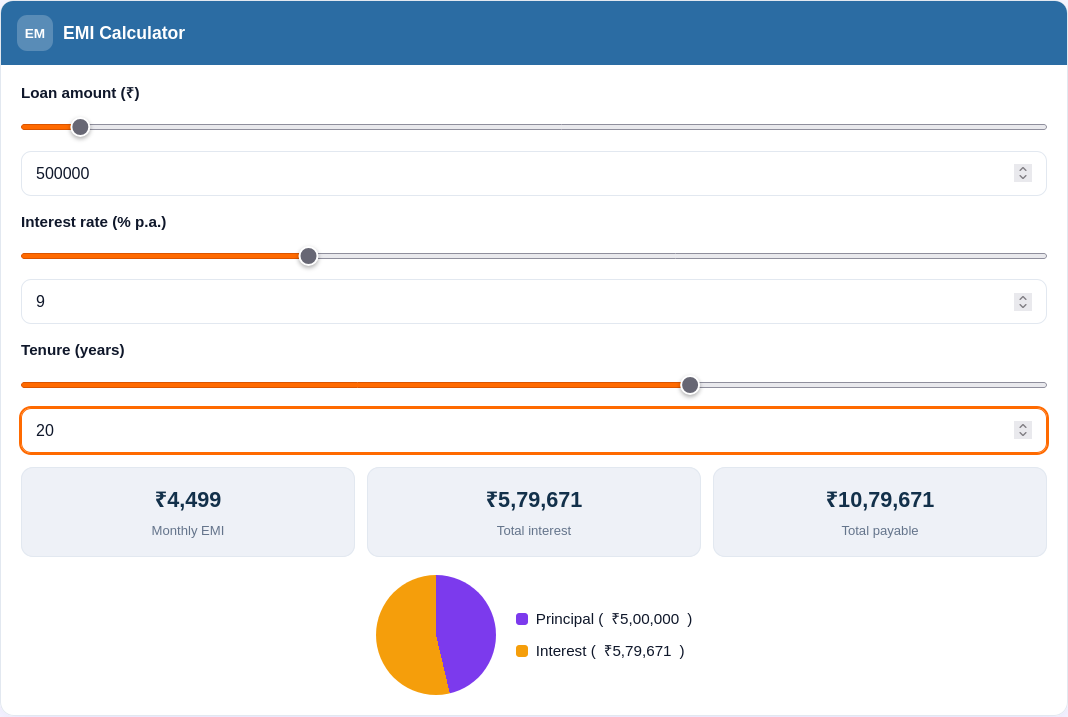
The comparison that matters is the first row against the third: the same Rs 5,00,000 loan at the same 9 percent. Stretching it from 5 years to 20 years cuts the EMI from Rs 10,379 to Rs 4,499 — 0.43 times, less than half — but the interest grows from Rs 1,22,751 to Rs 5,79,671 — 4.72 times. The page's own line says it plainly: stretching the loan nearly halves the EMI but more than quadruples the interest, and the test confirms it. The fourth row shows the same trap at a bigger scale: a Rs 10,00,000 loan over 20 years at 10 percent costs Rs 13,16,052 in interest alone — more than the amount borrowed.
| Tenure for Rs 10,00,000 at 9 percent | Monthly EMI | Total interest | Total payable |
|---|---|---|---|
| 5 years | Rs 20,758 | Rs 2,45,501 | Rs 12,45,501 |
| 10 years | Rs 12,668 | Rs 5,20,109 | Rs 15,20,109 |
| 15 years | Rs 10,143 | Rs 8,25,680 | Rs 18,25,680 |
| 20 years | Rs 8,997 | Rs 11,59,342 | Rs 21,59,342 |
Stretching the loan from 5 to 20 years nearly halves the EMI but more than quadruples interest. Pick the shortest tenure whose EMI still leaves room for monthly expenses.
One limitation: totals only, with no month-by-month schedule, so you cannot see how much of a single EMI is interest and how much is principal — the donut shows the overall split only. All figures are rounded to whole rupees.
What a 1% rate change does to your EMI
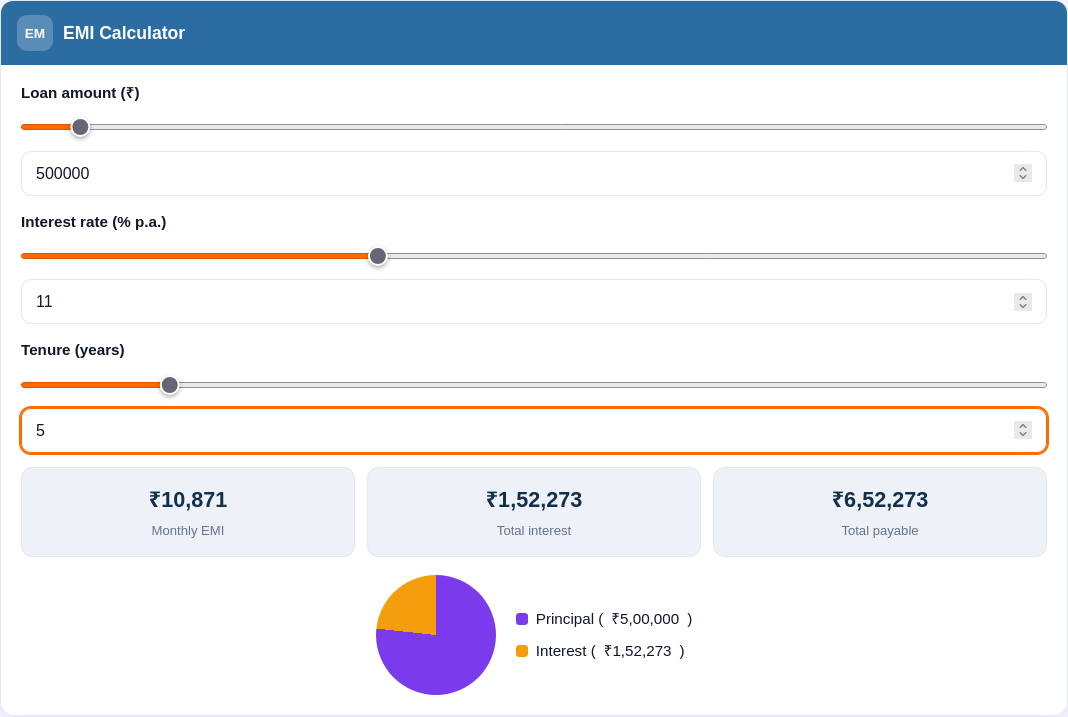
I ran the same Rs 5,00,000 loan for 5 years through the calculator at 9, 10 and 11 percent. Each 1 percent step adds about Rs 245 a month to the EMI, but roughly Rs 14,700 of extra interest over five years.
| Rate for Rs 5,00,000 over 5 years | Monthly EMI | Total interest | Total payable |
|---|---|---|---|
| 9% | Rs 10,379 | Rs 1,22,751 | Rs 6,22,751 |
| 10% | Rs 10,624 | Rs 1,37,411 | Rs 6,37,411 |
| 11% | Rs 10,871 | Rs 1,52,273 | Rs 6,52,273 |
9 to 10 percent: EMI +Rs 245 a month, interest +Rs 14,660. 10 to 11 percent: +Rs 247 a month, +Rs 14,862. Across the full gap the EMI is Rs 492 a month higher and the interest Rs 29,522 higher — all three rows matched the independent calculation to the rupee.
Before accepting an offer, ask what a 1 percent lower rate would need. On this loan that 1 percent is worth nearly Rs 15,000, more than one whole EMI.
Reading the donut: how much of your money is interest
Under the three results, the calculator shows a donut split between principal and interest. In the 5-year test the principal is 80.3% of everything you pay (Rs 5,00,000 of Rs 6,22,751); in the 20-year test it is only 46.3% (Rs 5,00,000 of Rs 10,79,671) — more than half of what you pay over 20 years is interest, not the loan. In the main test at 10 percent, principal is 78.4% of what you pay and interest 21.6%. That split is the fastest way to judge a loan: if the interest slice is bigger than the principal slice, the tenure is too long for that loan. Use the donut together with the three numbers, not instead of them.
Common EMI mistakes
- Judging by EMI alone. A low EMI over a long tenure usually means far more total interest. Compare total payable.
- Forgetting charges outside the EMI. This calculator covers principal plus interest only. Processing fees, GST on fees, insurance and penalties sit on top.
- Confusing flat with reducing rates. A flat rate charges interest on the full principal throughout and costs much more. Most home and car loans use the reducing method.
- Borrowing to the eligibility limit. Approval is not affordability. Many advisers suggest keeping total EMIs within about 40 percent of monthly income.
Practical tips before you sign
- Ask about part-prepayment charges; a yearly bonus paid against principal can cut years off a loan.
- Keep three to six months of EMIs as a buffer before taking a large loan.
- Confirm the exact figure with your lender before signing, since banks round differently and add charges.
Please note: The EMI shown here is an estimate for planning only. This is not financial advice — please confirm the final EMI, interest rate and charges with your bank or lender before taking a loan.
Frequently asked questions
What is EMI?
EMI (Equated Monthly Instalment) is the fixed amount you pay your lender every month until the loan is fully repaid. Each payment covers part of the principal and part of the interest.
What is the EMI formula?
EMI = P × r × (1+r)ⁿ / ((1+r)ⁿ − 1), where P is the principal, r is the monthly interest rate (annual rate ÷ 12 ÷ 100) and n is the number of monthly payments.
Does the EMI include processing fees or other charges?
No. This calculator shows principal plus interest only. Banks may add processing fees, GST on fees, insurance or penalties — factor those in separately.
Is the EMI shown accurate?
It is a close estimate using the standard reducing-balance formula. Your bank's exact figure may differ slightly due to rounding and charges, so confirm with your lender before signing.
Why is interest higher in the early EMIs?
Interest is charged on the outstanding balance, highest at the start. Each EMI first covers that month interest; only the rest reduces principal. As the balance falls, the interest share shrinks.
Should I choose a longer tenure for a lower EMI?
Only if the lower EMI is what makes the loan affordable at all. A longer tenure always raises total interest, often by lakhs, as the table shows. If your budget allows the shorter EMI, take it.
What is the difference between a flat rate and a reducing balance rate?
A flat rate charges interest on the original principal for the whole tenure, even as you repay. A reducing balance charges only on what you still owe, so it falls over time. This calculator uses the reducing method.
Does prepaying part of my loan reduce interest?
Yes, because prepayment cuts outstanding principal, and future interest is calculated on that smaller balance. Check for a prepayment fee first, and note that reducing tenure usually saves more than reducing EMI.
Want the full walkthrough with screenshots? Read the guide: How to Calculate EMI for a Loan in India — step by step →