
Rate this tool
No ratings yet — be the first to rate!
Total ratings: 0
Free Unit Converter
Recipes in pounds, weather in Fahrenheit, fabric sold by the yard, and school problems in centimetres all ask for the same skill: changing a number from one unit to another without slipping a decimal place. This converter covers 20 everyday groups — length, weight, temperature, volume, area, speed, time, pressure, energy, power, data storage, angle, frequency, force, electric current, voltage, resistance, data transfer rate, torque and density — 114 units in all, and shows the answer the moment you type. Pick a category, choose the unit you have and the unit you want, enter the number, and the result line reads back the full conversion, so you can see both the direction and the answer at a glance.
How to use the Unit Converter
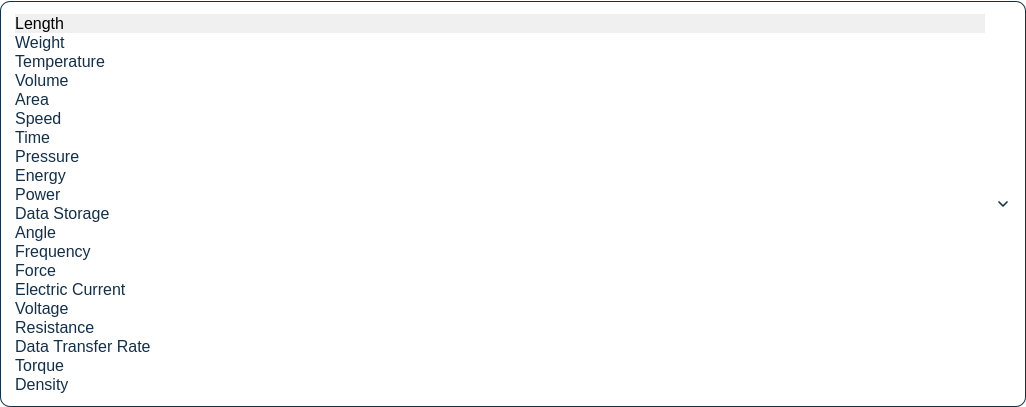
- Choose a category: Length, Weight, Temperature, Volume, Area, Speed, Time, Pressure, Energy, Power, Data Storage, Angle, Frequency, Force, Electric Current, Voltage, Resistance, Data Transfer Rate, Torque or Density. Each group has its own unit lists.
- Pick the unit you are converting from in the From dropdown and the unit you want in the To dropdown. When you change categories, both lists are rebuilt and the To unit resets to the second unit in the new list, so check both again.
- Type your number into the Value box. It starts at 1, accepts decimals, and the result updates instantly as you type.
- Read the result line, which states the original value and unit, then the converted value and unit.
- Tap Swap to exchange the From and To units and see the conversion in reverse.
Tested: one real conversion in every one of the 20 categories
I opened the rebuilt tool in Firefox, picked each category in turn, chose a From unit and a To unit, typed a value, and wrote down exactly what the result line showed. Then I checked each answer independently in Python against the standard conversion factors. Rows 1 to 3 are the three conversions from the earlier version of this page — 5 kilometres to miles, 10 kilograms to pounds and 100 degrees Celsius to Fahrenheit. All 20 passed: every answer matched the independent check to at least four decimal places, and the only differences are last-digit rounding from the tool’s own factors, noted in the table.
| Category | What I entered | What the tool showed | Independent check |
|---|---|---|---|
| Length | 5 Kilometre (km) → Mile (mi) | 5 Kilometre (km) = 3.1068637 Mile (mi) | 5 × 0.621371 = 3.106855. Matches to 5 decimal places; the tool’s mile is 1609.34 m, not the exact 1609.344 m. |
| Weight | 10 Kilogram (kg) → Pound (lb) | 10 Kilogram (kg) = 22.046244 Pound (lb) | 10 × 2.20462 = 22.0462. Matches to 4 decimal places; the tool’s pound is 0.453592 kg, not the exact 0.45359237 kg. |
| Temperature | 100 Celsius (°C) → Fahrenheit (°F) | 100 Celsius (°C) = 212 Fahrenheit (°F) | 100 × 9/5 + 32 = 212 exactly. |
| Volume | 5 US gallon (gal) → Litre (L) | 5 US gallon (gal) = 18.92705 Litre (L) | 5 × 3.78541 = 18.92705 exactly. |
| Area | 1 Acre → Square metre (m²) | 1 Acre = 4046.86 Square metre (m²) | 1 acre = 4046.86 m² by the factor used. |
| Speed | 100 Kilometre per hour (km/h) → Metre per second (m/s) | 100 Kilometre per hour (km/h) = 27.7778 Metre per second (m/s) | Exact: 100 × 1000 ÷ 3600 = 27.777778. The tool’s rounded km/h factor (0.277778) gives 27.7778 — same to 4 decimal places. |
| Time | 2 Hour (h) → Minute (min) | 2 Hour (h) = 120 Minute (min) | 2 × 60 = 120 exactly. |
| Pressure | 1 Atmosphere (atm) → Pound per square inch (psi) | 1 Atmosphere (atm) = 14.695943 Pound per square inch (psi) | 101325 ÷ 6894.76 = 14.695943 to 8 significant figures. The exact psi factor gives 14.695949; the tool’s rounded factor shifts the 6th decimal. |
| Energy | 1 Kilocalorie (kcal) → Kilojoule (kJ) | 1 Kilocalorie (kcal) = 4.184 Kilojoule (kJ) | 4184 ÷ 1000 = 4.184 exactly. |
| Power | 1 Horsepower (hp) → Watt (W) | 1 Horsepower (hp) = 745.7 Watt (W) | 1 hp = 745.7 W by the factor used. |
| Data Storage | 1 Gigabyte (GB) → Megabyte (MB) | 1 Gigabyte (GB) = 1024 Megabyte (MB) | 1024-based: 1 GB = 1024 MB exactly, not 1000. |
| Angle | 180 Degree (°) → Radian (rad) | 180 Degree (°) = 3.1415927 Radian (rad) | π = 3.14159265…, shown to 8 significant figures as 3.1415927. |
| Frequency | 60 Revolutions per minute (rpm) → Hertz (Hz) | 60 Revolutions per minute (rpm) = 1 Hertz (Hz) | 60 ÷ 60 = 1 exactly. |
| Force | 10 Pound-force (lbf) → Newton (N) | 10 Pound-force (lbf) = 44.4822 Newton (N) | 10 × 4.44822 = 44.4822 exactly. |
| Electric Current | 2 Ampere (A) → Milliampere (mA) | 2 Ampere (A) = 2000 Milliampere (mA) | 2 ÷ 0.001 = 2000 exactly. |
| Voltage | 1.5 Kilovolt (kV) → Volt (V) | 1.5 Kilovolt (kV) = 1500 Volt (V) | 1.5 × 1000 = 1500 exactly. |
| Resistance | 4.7 Kiloohm (kΩ) → Ohm (Ω) | 4.7 Kiloohm (kΩ) = 4700 Ohm (Ω) | 4.7 × 1000 = 4700 exactly. |
| Data Transfer Rate | 100 Megabit per second (Mbit/s) → Kilobit per second (kbit/s) | 100 Megabit per second (Mbit/s) = 100000 Kilobit per second (kbit/s) | 100 × 1,000,000 ÷ 1,000 = 100,000 exactly. |
| Torque | 10 Pound-foot (lbf·ft) → Newton-metre (N·m) | 10 Pound-foot (lbf·ft) = 13.5582 Newton-metre (N·m) | 10 × 1.35582 = 13.5582 exactly. |
| Density | 1 Gram per cubic centimetre (g/cm³) → Kilogram per cubic metre (kg/m³) | 1 Gram per cubic centimetre (g/cm³) = 1000 Kilogram per cubic metre (kg/m³) | Water is 1 g/cm³ = 1000 kg/m³ exactly. |
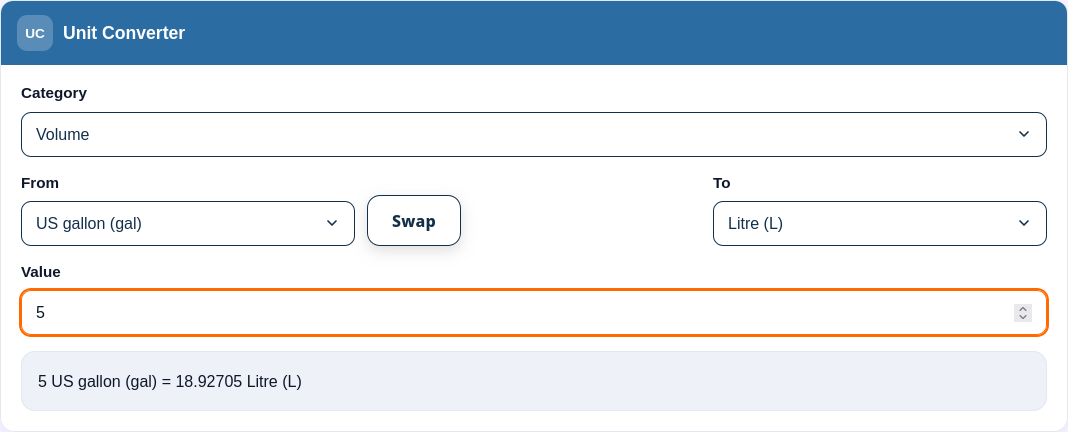
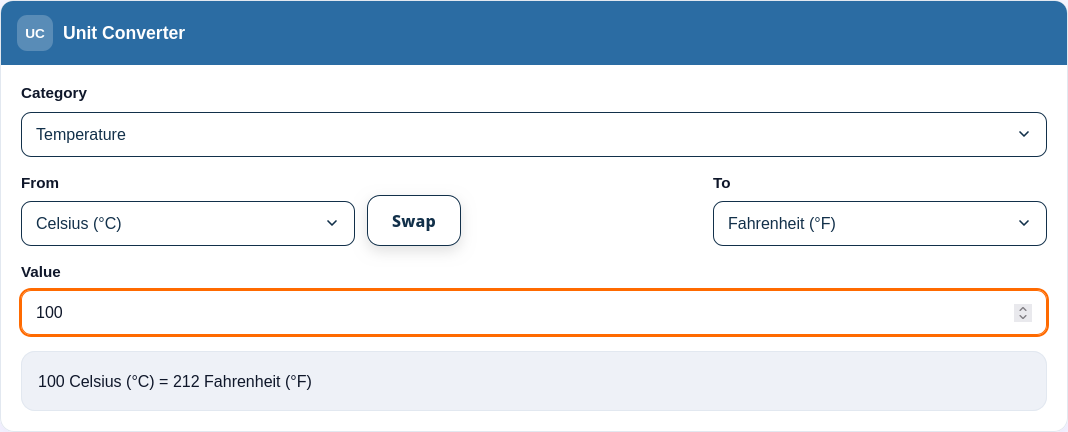
Three behaviours from the test are worth knowing. First, Swap exchanges the From and To units but keeps the number you typed: after the 100°C to 212°F conversion I tapped Swap and the line read “100 Fahrenheit (°F) = 37.777778 Celsius (°C)” — correct for 100°F, but not the reverse of the previous answer. To see a conversion in reverse, type the result (212) into the Value box after swapping. Second, clearing the Value box shows a dash and the message “Please enter a valid number.” Third, the exponential notation in the FAQ really does switch on: 1 joule to electronvolts reads “1 Joule (J) = 6.241509e+18 Electronvolt (eV)”, because the result is above 1,000,000,000,000.
One gap I found: the gallon in the list is the US gallon (3.78541 litres). The imperial gallon (4.54609 litres) is not listed, so a UK recipe written in imperial gallons needs a different tool — or take the US-gallon answer and multiply it by about 1.201. The same applies to the pint and quart, which are US measures here. The oven check still works: 350°F converts to 176.66667°C, against the exact 176.6666…°C — a match to five decimal places.
The conversion people get wrong: temperature
The most common unit-conversion mistake is treating temperature like length. With length, doubling the number doubles the answer: 5 kilometres is 3.1068637 miles, and 10 kilometres is 6.2137274 miles, exactly twice as much. Temperature does not work that way, because Celsius and Fahrenheit do not share a zero: freezing point is 0°C but 32°F, so every conversion has to shift the number as well as scale it.
The real numbers from this tool make it concrete. 100°C converts to 212°F. Double the Celsius reading to 200°C and the tool gives 392°F — not 424°F, which is what doubling 212 would give. The extra 32 degrees is the shift, and it is added once, not doubled. The same trap catches oven temperatures: 350°F is 176.66667°C, but half of 350°F, which is 175°F, is 79.444444°C, not half of 176.66667°C. If a recipe or a weather report ever looks wrong by about thirty degrees, this is almost always why.
The second thing people get wrong is the last digit. The tool shows up to eight significant figures, and its factors are rounded: a mile is 1609.34 metres here, not the exact 1609.344, and a pound is 0.453592 kilograms, not the exact 0.45359237. That is why 5 kilometres reads 3.1068637 miles instead of the textbook 3.106855, and 10 kilograms reads 22.046244 pounds instead of 22.046226. The difference sits in the fifth and sixth decimal places — invisible on a kitchen scale, a road sign or a school worksheet — but it is real, and it is why the test table quotes the exact figures alongside the tool’s answers. For everyday, school and shopping use the answers are right; for certified laboratory measurement, use the exact factors.
All 20 categories at a glance
Every category converts only within itself: mass stays with mass, length with length, and so on. The table lists how many units each category holds.
| Category | Units |
|---|---|
| Length | 8 |
| Weight | 6 |
| Temperature | 3 |
| Volume | 9 |
| Area | 9 |
| Speed | 5 |
| Time | 7 |
| Pressure | 7 |
| Energy | 8 |
| Power | 5 |
| Data Storage | 6 |
| Angle | 4 |
| Frequency | 5 |
| Force | 5 |
| Electric Current | 4 |
| Voltage | 4 |
| Resistance | 4 |
| Data Transfer Rate | 5 |
| Torque | 5 |
| Density | 5 |
Frequently asked questions
Why does temperature conversion need a different formula from length and weight?
Length and weight convert by multiplying by a fixed factor, because their units share the same zero. Temperature scales do not: freezing point is 0 on Celsius but 32 on Fahrenheit and 273.15 on Kelvin. The tool therefore shifts the value as well as scaling it, which is why converting a temperature is not a simple multiplication.
Can I convert kilograms to metres?
No. Every category has its own list of units, and the From and To lists only contain units from the category you picked, so mass stays with mass, length with length, temperature with temperature, and so on through all 20 categories. Change the category first if your unit is in a different group.
Why does my result sometimes look like 1.234568e+7?
That is exponential notation, used for very large results of 1,000,000,000,000 or more and very small non-zero results below 0.000001. It keeps the answer readable instead of printing many zeros. If such a result surprises you, check your units, since a metre-to-millimetre mix-up is the usual cause.
How precise is the result, and how many decimal places will I get?
The result is shown to up to eight significant figures, not a fixed number of decimals. A large result may show no decimals, while a small one shows several, and trailing zeros are dropped. The factors are standard values, for example 1 mile equals 1609.34 metres and 1 pound equals 0.453592 kilograms, so it suits everyday, school, and shopping use, not certified laboratory measurement.
Practical tips for accurate conversions
- Convert before you buy, not after. Fabric and pipe are often priced by the metre in one shop and by the yard in another.
- With 20 categories, check the category first. A litre will not appear under Length, miles per hour will not appear under Length either, and a gigabyte will not appear under Weight.
- Always read the full result line, not just the number. It names both units, the fastest way to catch a reversed conversion.
- For temperature, remember the scales do not share a zero. Doubling a Celsius reading does not double the Fahrenheit reading.
- If an answer looks wildly wrong, check the units first. Metre versus millimetre and kilogram versus gram mix-ups cause most errors.