
BMI is a screening guide, not a diagnosis.
Rate this tool
No ratings yet — be the first to rate!
Total ratings: 0
Free BMI Calculator
A single number can show whether your weight sits in a healthy range for your height, and this calculator gives you that number in seconds. Enter your height and weight in centimetres and kilograms, or in feet, inches and pounds, and you get your BMI, your category, and the weight range that counts as healthy for your height. Use it as a quick check before a doctor's visit, a fitness plan, or a medical form for school or a job.
How to use the BMI Calculator
- Choose Metric if you measure in centimetres and kilograms, or Imperial for feet, inches and pounds.
- Type in your height and your current weight. The result updates as you type, so there is nothing to submit.
- Read your BMI number, its category, and the marker on the colour bar showing where you sit in the full range.
- Note the healthy weight range shown for your height. That range, not a single magic number, is the useful target.
- Weigh again under the same conditions, such as first thing in the morning, to track change over time.
The BMI formula, worked out step by step
The formula is simple: BMI equals weight in kilograms divided by height in metres squared. In the imperial system, it is weight in pounds divided by height in inches squared, multiplied by 703.
The formula is easy to check by hand — and I checked it against the calculator itself. The three runs below are real test values typed into the tool on this page, with every number cross-checked in Python.
| BMI range | Category (WHO) | What it usually means |
|---|---|---|
| Below 18.5 | Underweight | May need a diet and health check |
| 18.5 – 24.9 | Normal | Healthy weight for height |
| 25.0 – 29.9 | Overweight | Health risk rises over time |
| 30.0 and above | Obese | Higher risk; see a doctor |
India-specific note: Indian consensus uses lower cut-offs for Asian Indians, 23 for overweight and 25 for obese, because risks such as diabetes appear at lower weights here. So a BMI of 24, normal globally, already warrants attention for an Indian adult.
Tested: three real runs through the calculator
I typed three sets of test values into the calculator on this page — no real person’s measurements — and wrote down exactly what it showed. Every number was then cross-checked in Python (BMI = kg ÷ m²); the tool and Python agreed to one decimal place on all three runs.
| Run | Height | Weight | BMI | Category | Healthy range | Marker |
|---|---|---|---|---|---|---|
| A — Metric | 170 cm | 70 kg | 24.2 | Normal | 53.5–72.0 kg | 39.3% |
| B — Metric | 160 cm | 85 kg | 33.2 | Obese | 47.4–63.7 kg | 73.9% |
| C — Imperial | 5 ft 7 in | 154 lbs | 24.1 | Normal | 53.6–72.1 kg | 38.9% |
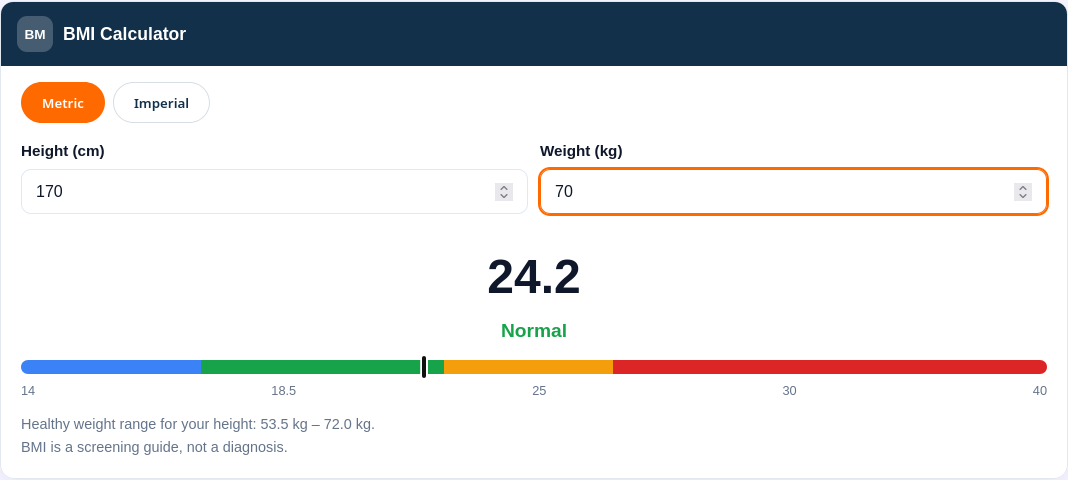
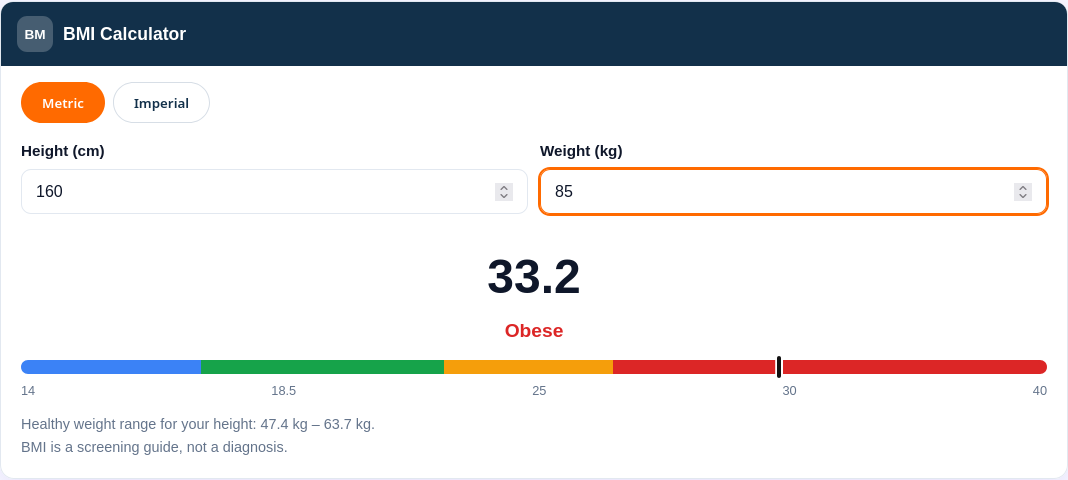
Two things are worth noticing. First, runs A and C are the same body measured in two unit systems — 170 cm and 70 kg against 5 ft 7 in and 154 lbs — and the answers differ by a tenth: 24.2 against 24.1. That is the rounding the FAQ below warns about, now measured rather than assumed: 5 ft 7 in is 170.18 cm, not 170 cm, and 154 lbs is 69.85 kg, not 70 kg, so the imperial run is measuring a slightly taller, slightly lighter body, and the tool rounds to one decimal place. Second, the marker on the colour bar sits where the number says it should: 39.3% along a bar that runs from 14 to 40 for run A, just inside the green, and 73.9% for run B, deep in the red. The healthy range moves with the height too — 53.5–72.0 kg at 170 cm against 47.4–63.7 kg at 160 cm — which is why the next section matters.
The healthy range belongs to your height, not your weight
Look at the two healthy ranges in the table above: 53.5–72.0 kg at 170 cm, 47.4–63.7 kg at 160 cm. Ten centimetres of height moved the low end by 6.1 kg and the high end by 8.3 kg, and the range itself narrowed from 18.5 kg wide to 16.3 kg wide. What did not move the range at all was the weight: at 160 cm the range is 47.4–63.7 kg whether the person weighs 60 kg or 85 kg. Only the marker moves. That is why the range, not a single target weight, is the useful number to remember — and why chasing one magic number, say exactly 60 kg, misses the point. Any weight inside the range counts as healthy for that height.
Practical tips and common mistakes
The most common mistake is entering height in centimetres into the metres formula, which gives a nonsense result near zero. This calculator converts for you, but by hand, always divide centimetres by 100 first. Another error is weighing after a heavy meal, in heavy clothes, or on different scales each week, which hides real change behind daily noise. Weigh at the same time of day, on the same scale.
Do not treat BMI as a verdict alone. It cannot tell muscle from fat, so a gym trainer may score high while fit, and an older adult may score normal while carrying too little muscle. Children, pregnant women, and athletes need age-specific charts or a doctor's advice, not adult bands. And do not chase decimals: 24.8 versus 25.1 is meaningless, but the trend over months matters.
If you switch between metric and imperial while tracking, expect the number to move by about a tenth even when nothing changed — I measured 24.2 in metric and 24.1 in imperial for the same body. Pick one system and stick to it, or your trend line will wobble for no reason.
Frequently asked questions
What is BMI?
BMI (Body Mass Index) is weight in kilograms divided by the square of height in metres. It is a widely used screening measure for weight-related health risk.
What is a healthy BMI range?
18.5–24.9 is considered normal. Below 18.5 is underweight, 25–29.9 is overweight, and 30 or above is obese.
Is BMI accurate for athletes or muscular people?
Not always — muscle weighs more than fat, so very muscular people can show a high BMI while being fit. Pregnant women and the elderly should also treat it as a rough guide and consult a doctor.
Is this BMI calculator free?
Yes — free, private and no sign-up. All calculations happen in your browser.
Why does my BMI change slightly when I switch between metric and imperial?
Rounding. Feet and inches round to whole numbers, and pounds convert at 0.453592 kg each, so the result can shift by a tenth or two. For the steadiest result, enter centimetres and kilograms.
Can children use this BMI calculator?
The number will calculate, but adult categories do not apply. A child's BMI is judged against age- and sex-specific growth percentiles, since healthy BMI changes as children grow. Ask a paediatrician to interpret it.
How do I use BMI to set a target weight?
Use the healthy weight range for your height, not one fixed number. Aim for slow change of roughly half a kilogram a week through food and activity, and re-check monthly, not daily.
Why do two people with the same BMI look so different?
BMI uses only height and weight, ignoring where fat sits and how much is muscle. Two people at BMI 26 can differ greatly in waist size, fitness, and risk. Waist size and activity add context BMI cannot give.
How much weight would I need to lose to reach a Normal BMI?
It depends on your height, because the top of the Normal range is 24.9 × your height in metres squared. For the 160 cm test case on this page, the top of Normal is 63.7 kg, so from 85 kg that is 21.3 kg to lose. At the slow, steady rate of about half a kilogram a week, that is roughly 43 weeks — about ten months. The calculator shows your own top-of-Normal number in the healthy weight range line, so use that instead of guessing.