
Rate this tool
No ratings yet — be the first to rate!
Total ratings: 0
Free Age Calculator
Exact age matters on real paperwork: school admission, government job forms, pension applications, and exam eligibility all ask for age in years, months, and days, not just a round number. This calculator turns any date of birth into that exact figure, plus days lived, your birth weekday, and a next-birthday countdown.
How to use the Age Calculator
- Tap the date field and pick your date of birth; the picker blocks future dates, so a slip cannot produce a negative age.
- Your exact age appears at once in years, months, and days, with total days lived.
- Check your birth weekday, and your next birthday with days remaining.
- If the result looks wrong by a day, check that your device date is correct, since the calculation uses your device's local date.
- For an official form, cross-check the figure against your birth certificate or Aadhaar date of birth before writing it down.
Tested: two birth dates through the calculator
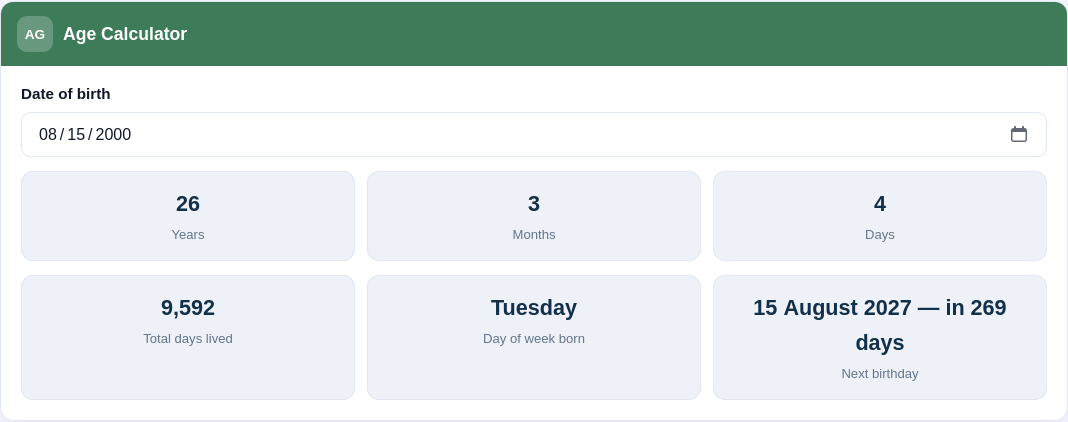
Instead of describing what the calculator should do, I ran two test dates of birth through it and checked every number against an independent calculation in Python. Both dates are test dates, not real people: 15 August 2000, and 29 February 2000, a leap-day birthday. I ran them on 19 November 2026, so the figures below are a snapshot from that day. Run the same dates today and the days will have moved on, because the calculator always counts from today's date.
| Date of birth (test date) | Exact age | Total days lived | Born on | Next birthday |
|---|---|---|---|---|
| 15 August 2000 | 26 years, 3 months, 4 days | 9,592 | Tuesday | 15 August 2027 — in 269 days |
| 29 February 2000 | 26 years, 8 months, 21 days | 9,760 | Tuesday | 1 March 2027 — in 102 days |
The first date shows the borrowing rule in its simplest form. From 15 August 2000 to 19 November 2026 the year difference is 26, the month difference from August to November is 3, and the 19th is later than the 15th, so nothing is borrowed: 26 years, 3 months, 4 days. The total days lived, 9,592, is the straight count of days between the two dates, and it matches the Python count exactly. That check matters more than it looks: dividing 9,592 by 365 gives 26.28, not a clean age, because the count includes leap days and uneven months.
The second date is the one that tests the calculator. From 29 February 2000 to 19 November 2026 the month difference from February to November is 9, but the 19th is earlier than the 29th, so one month is borrowed: 8 months remain, and the days become 19 plus October's 31 days, minus 29, which is 21 days — 26 years, 8 months, 21 days, and 9,760 days lived. Python agrees on every number, including the weekday: both test dates were Tuesdays.
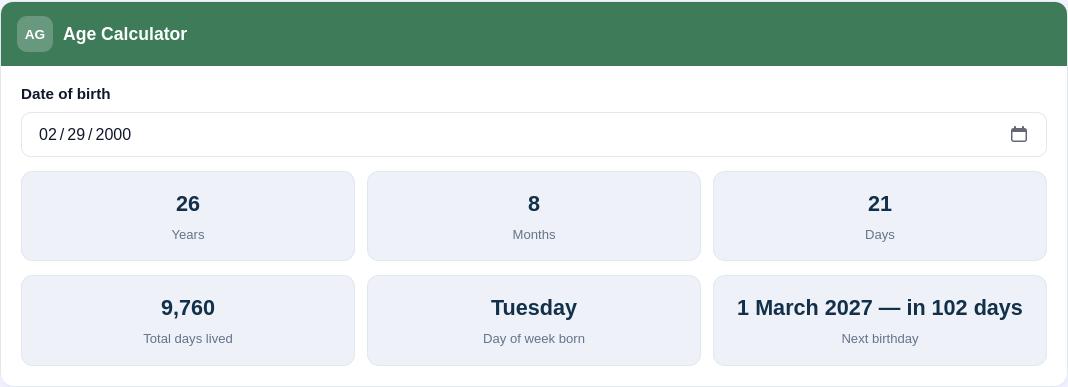
Two honest findings came out of the test. First, the next-birthday countdown for the leap-day birthday points at 1 March 2027, not 28 February — in a year with no 29 February the date rolls forward, and the countdown is 102 days to that rolled date. Second, the results depend on your device's date: the calculator uses the calendar date on your phone or computer, so if that clock is a day out, the days-lived count is a day out too. I also tried a future date, 1 January 2030: the calculator refused it with “Date of birth cannot be in the future.” — the picker blocks future dates the same way.
What a 29 February birthday does to the next-birthday countdown
A birthday on 29 February exists only in leap years, so in the other three years out of four the question is where the birthday goes. Offices split on this: some observe it on 28 February, others on 1 March, and the difference is a whole day in the countdown. This calculator takes the 1 March side. For the test date 29 February 2000 it showed the next birthday as 1 March 2027, in 102 days. That is the calendar's own behaviour — a date that does not exist rolls forward to the next day that does — and 2000 was a leap year only because it is divisible by 400: a century year is a leap year only then, which is why 1900 was not one and 2000 was.
The age itself is not affected. The borrow method counts completed months and days from 29 February regardless of which day the birthday is observed on, so the 26 years, 8 months, 21 days stands either way. What changes is only the countdown label and the day count to the next birthday. In a leap year the birthday lands on 29 February itself and the countdown runs to that date. If a form asks for your birthday and you were born on 29 February, write what your birth certificate or Aadhaar says, and check how the office that issued it records the date in non-leap years — the calculator cannot know that for you.
Practical tips and common mistakes
The most common mistake is mixing up day and month, especially with dates like 04/11, read as 4 November on some forms and April 11 on others. Use the picker, not typing, and confirm the month name. Another trap is the cut-off date: recruitment notices often ask for age as on 1 January or 1 July of a year, not age today. This calculator gives age today, so for a cut-off date you must count from that date.
People born on 29 February may find systems record their birthday differently in non-leap years, so check your documents first. And age for admission or retirement counts completed years on the cut-off date: a child of 5 years and 11 months is still 5, not 6.
Write the age down the day you check it. The days-lived figure moves by one every midnight, so a result noted today is already a day old tomorrow — and the years, months and days shift the same way on your birthday.
Frequently asked questions
How is the age calculated?
Using the standard borrow method: months and days are adjusted when the current day is earlier than the birth day, exactly the way official age calculations work.
Which timezone is used?
Your device's local date. Results reflect the calendar date on your phone or computer.
How is the next birthday found?
Your birthday this year — or next year if it has already passed — and the number of days remaining until then.
Is this age calculator free?
Yes — free, private and no sign-up. Everything runs in your browser.
Why does my age differ by one day on different websites?
Mostly timezones and device dates: this calculator uses your device's local date, another site its server's timezone. If your device clock is a day out, or you check just past midnight, the day count shifts by one.
How is the age of someone born on 29 February counted?
The same borrowing applies, with the birthday on 29 February in leap years. In other years offices observe it on 28 February or 1 March, so the day count can vary by one day.
What does age as on a particular date mean on a form?
It means completed age on that fixed date, not today. Notifications commonly fix a date such as 1 January of the recruitment year, and eligibility is judged on it. This calculator shows age today, so use the cut-off date when a form specifies one.
Does the calculator count the day I was born as day one?
No. Age counts completed time since birth: zero days old on your birth date, one year only on your first birthday. A baby born yesterday is 1 day old, not 2.
Why does the calculator show 1 March as the next birthday for someone born on 29 February?
In a non-leap year there is no 29 February, so the calendar rolls the date forward to the next day that exists, 1 March. This calculator counts the next birthday that way: for the test date 29 February 2000 it showed 1 March 2027, in 102 days. Some offices observe the birthday on 28 February instead, so if the exact day matters on a form, check what your documents say.