
Drag & drop a PDF here or browse files
PDF files only
No PDF loaded yet.
Drag & drop multiple PDFs here or browse files
Select as many PDFs as you like
No PDFs selected yet.
No size target — slider at the default 60%.
Move the slider to see a size estimate.
Rate this tool
No ratings yet — be the first to rate!
Total ratings: 0
Compress PDF to 200KB
A job portal caps uploads at 200KB, and a two-page resume with a photo often lands just above that line. To compress PDF to 200KB, drop the file in, let the tool rebuild its pages at a quality that fits inside 200KB, and download a copy ready to attach to the application. The original file stays untouched on your device, there is no account to create, and the download carries no watermark. Below, the exact numbers from a test run on 14 November 2026 — including the quality setting that finally got a two-page resume under 200KB.
Compress PDF to 200KB in five steps
- Upload a PDF by dragging it onto the box or clicking to browse. For several files, switch to Bulk PDFs and add them all at once.
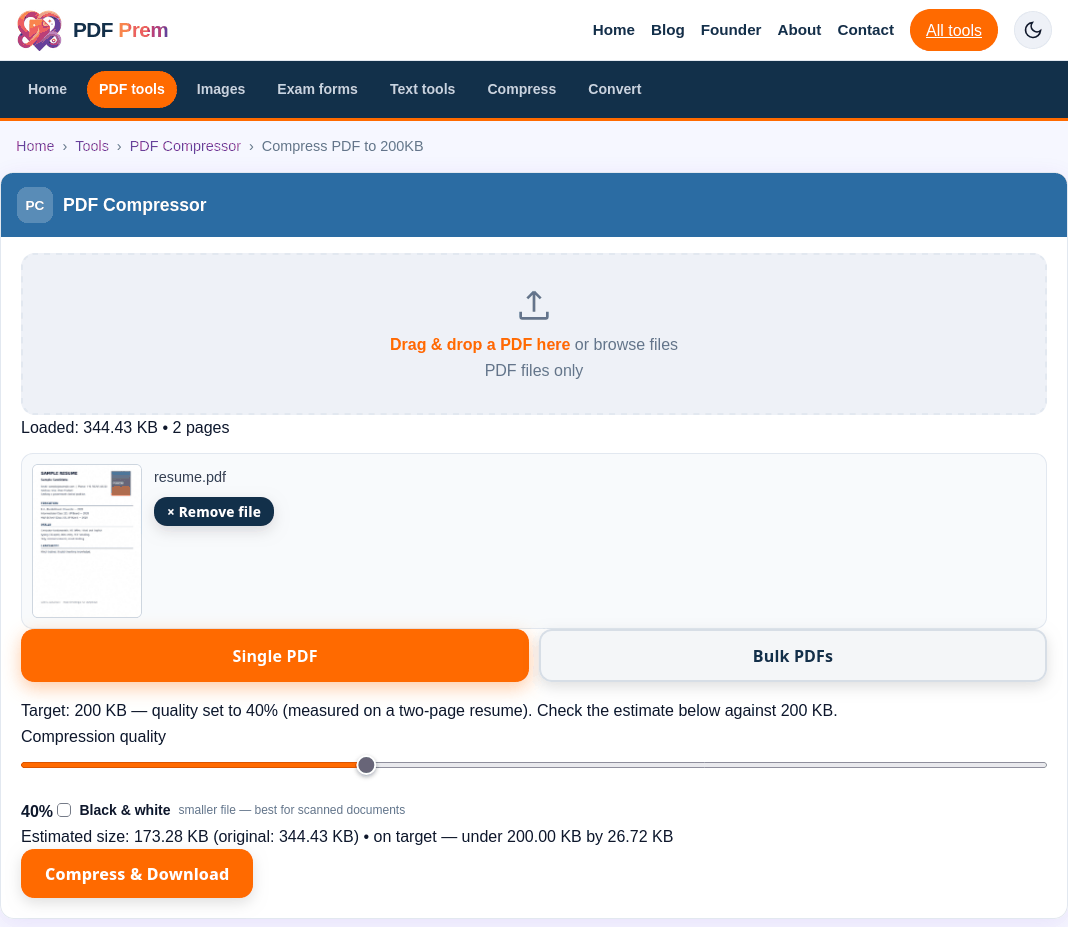
- The 200KB preset is already selected above, setting quality to 40% — the setting our test needed to fit a two-page resume under 200KB. Watch the live size estimate; if it overshoots, nudge the slider down.
- For black-and-white scans, tick Black & white to drop colour data — but do not expect a big saving from this alone: on my test file it saved under 1%, so use the quality slider for the real size cut.
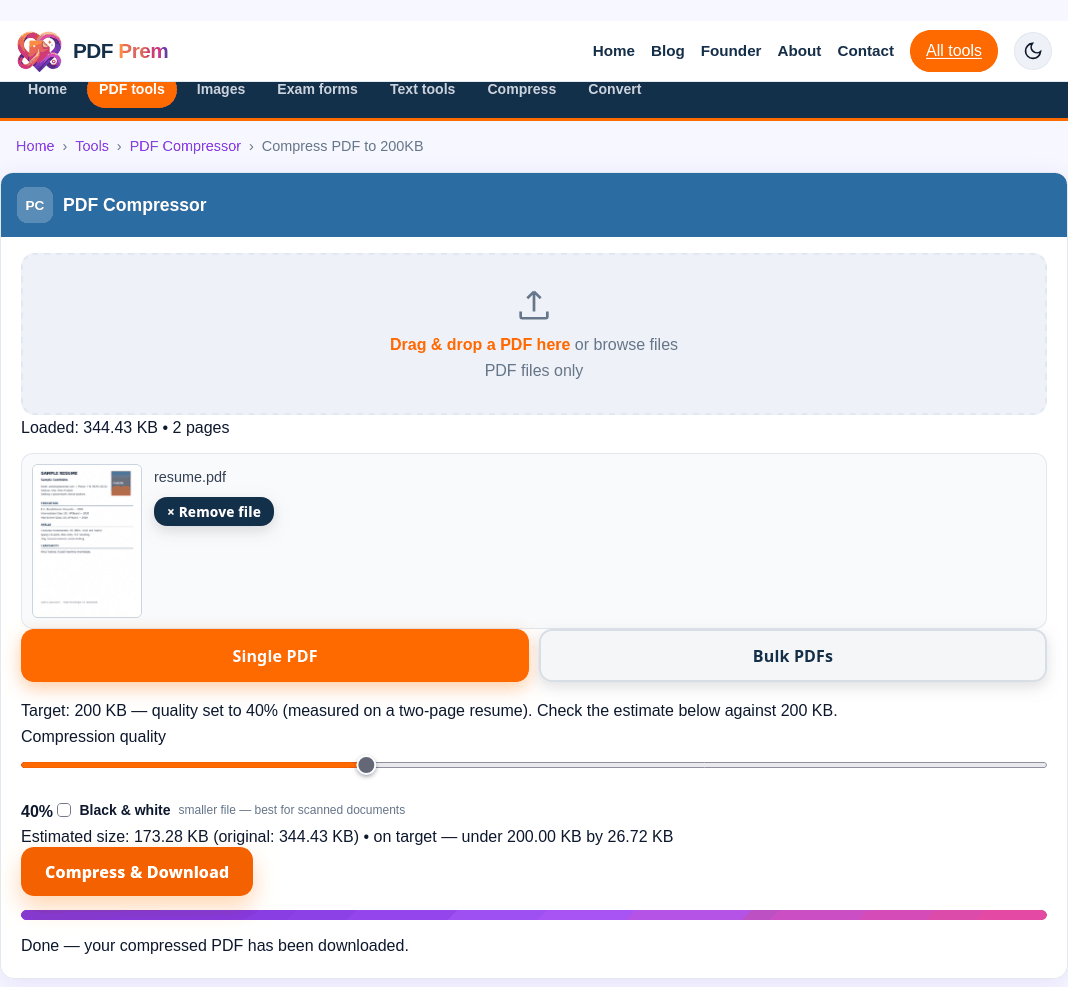
- Click Compress & Download and wait for the progress bar. If the estimate warns the result would be bigger than the original, lower the quality or skip that file.
- Open the download and check a text page and a photo page before sending, since quality loss differs on each.
Compress PDF to 200KB — for job applications
Tested on 14 November 2026: a two-page resume, fitted under 200KB
We ran this tool ourselves on 14 November 2026 with a sample two-page resume made for the test: page 1 carries a passport photo, education and skills; page 2 carries experience, projects and a declaration. The file was 344.43 KB — a typical size for a resume with a photo, and just over the 200KB cap many job portals set. We uploaded it and moved the quality slider down step by step. Here is what the tool estimated, and what actually downloaded:
| Quality slider | Tool’s estimate | Downloaded file | Under 200KB? |
|---|---|---|---|
| 60% (default) | 244.07 KB | 258.7 KB | No |
| 50% | 210.96 KB | 219.6 KB | No — just over |
| 40% | 173.28 KB | 185.2 KB | Yes |
Two things are worth knowing before you try this yourself. First, the estimate runs a little low: the tool renders only the first page and multiplies by the page count, so the real file came out about 6% bigger than the estimate each time — 219.6 KB against an estimate of 210.96 KB at 50%. Trust the downloaded file’s size, not the estimate, when a portal is strict. Second, unlike the tighter 100KB limit, we did not need the bottom of the slider: 40% did the job, and the default 60% was already close. We opened the downloaded file and checked it: both pages are there, the passport photo still looks like a photo, and the headings and body text are crisp. A recruiter reading this resume on screen would not know it had been compressed.
The 200KB page budget, measured
How many resume pages can 200KB actually hold? We measured it with the same resume set, compressing 1, 2, 3, 4 and 5 pages at the default 60% quality. The 5th page was a second scan of resume page 1, so the per-page cost stays comparable:
| Pages in the file | Original size | Compressed at 60% | Fits in 200KB? |
|---|---|---|---|
| 1 (resume page 1) | 166.09 KB | 125.3 KB | Yes, easily |
| 2 (full resume) | 344.43 KB | 258.7 KB | No — needs 40% |
| 3 (+ certificate) | 506.54 KB | 382.9 KB | No |
| 4 (+ portfolio) | 665.61 KB | 502.5 KB | No |
| 5 (+ second scan) | 843.44 KB | 633.4 KB | No |
At the default 60% quality each resume page costs roughly 125–133 KB, so the honest answer is: one page fits comfortably, a two-page resume needs the slider at 40%. That is the normal case — most resumes are two pages, and 40% is a gentle setting that keeps the photo and the text looking right, as the test above shows.
Where does 200KB sit in everyday use? It is the sweet spot for email. A 185KB resume attaches to any email in a second, stays far below the attachment limits mail providers set, and never bounces for size — the exact problem a 2–5MB scanned resume can cause on a slow connection. The same file uploads to every job portal that asks for under 200–500KB, and it forwards cleanly on WhatsApp when a recruiter asks for your resume in chat. If your file is longer — a resume plus certificates plus a portfolio, like the 5-page file above at 633.4 KB — do not keep pushing the slider down. Send the resume on its own, and keep the certificates as a second file: the portal, and the recruiter, will both prefer it that way.
Keep the photo, lose the weight
200KB is a forgiving target — you rarely need extreme settings. Start near the middle of the quality slider and nudge down only if the estimate overshoots. For black-and-white scans, the grayscale habit saves a surprising amount: colour data costs kilobytes that buy nothing on printed text.
Photos in the document matter most. If a single photo-heavy page eats the budget, consider compressing images first with our image compressor, then rebuilding the PDF.
What compression takes away from a resume
Reaching 200KB works by re-rendering every page as an image, which is ideal for scanned resumes and certificates — but it does change the file in a few ways that matter. The compressed copy is image-only. It matters in one specific way: if a recruiter needs to copy text from your resume — to paste your phone number or search for a skill — the compressed copy won't let them, because the words are now part of a picture. Recruiters can still read everything normally, and the file uploads and prints fine. But if the job post says the hiring system reads resumes automatically, send the original instead of the compressed copy, or keep a text version ready. The same applies to any form you still need to fill in: compress a copy for upload, keep the original for editing.
When compression makes the file bigger
Not every PDF should be compressed, and the tool tells you so before you waste a download. We also tested a 6-page plain-text notes file — real text, no images at all, just 5,378 bytes (5.25 KB). At 60% quality the tool estimated 730.03 KB and warned, in plain words, that the result would be bigger than the original. We clicked Compress anyway to see what happens: the tool finished the work, reported that the compressed file was 735.98 KB — about 137 times the original — and did not offer a download. That is the correct behaviour. Turning text pages into JPEG images costs far more bytes than the text itself, so a text-only PDF can only grow.
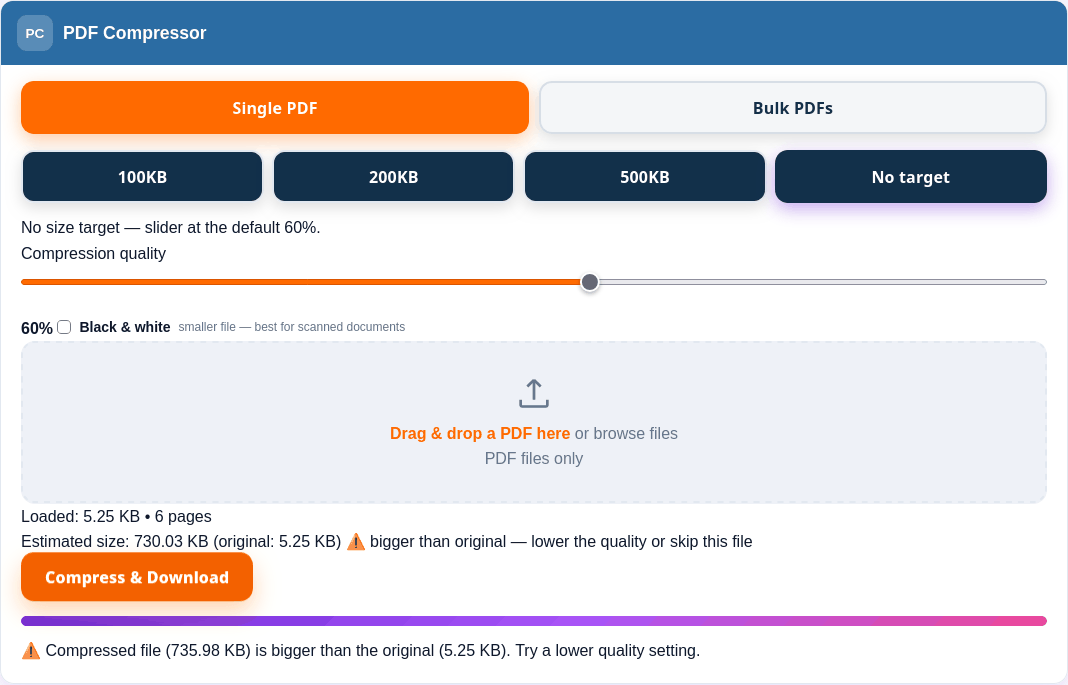
So before you compress, look at what your PDF is made of. If you can select the words with your mouse, it is a text PDF and compression will probably hurt it — send the original instead. If the pages are scans or photographs, compression is where this tool earns its keep. And if the estimate shows a warning, believe it: lower the quality a long way, or skip that file entirely.
How the size estimate works — and how close it runs
The estimate is simple: the tool compresses the first page at your quality, then multiplies by the page count. That is why it appears within a second of loading a file, and why it is an estimate rather than a promise. On the test file it ran 1–2% low at every setting (3.01 MB estimated vs 3.05 MB downloaded at 90%; 1.90 MB vs 1.93 MB at 70%; 1.23 MB vs 1.25 MB at 50%), because later pages cost slightly more than the first. Photo pages run larger than text pages, so if your first page is mostly blank and the rest are photographs, the real file will overshoot the estimate by more — treat it as a guide and check the real download size.
| Quality setting | Best for | What to expect |
|---|---|---|
| 80–100% | Keeping documents near original quality | Modest savings, crisp output |
| 50–70% | Everyday emailing and uploads | Big savings, text still readable |
| 30–50% | Hitting a strict portal size limit | Smallest files; fine print softens |
| Black & white mode | Scanned forms and certificates | Rarely smallest — under 1% saved on our test file |
One more thing the estimate cannot tell you: it says nothing about readability. A 50% file can be a quarter of the size and still read perfectly, as this test showed, or it can blur a faint signature into nothing. Only your own eyes can judge that, on the downloaded file, before you upload it anywhere.
Before you send it: three checks from the test
Keep your original file. Compression here re-renders every page as an image — great for scans, but the compressed copy is image-only. Never compress the only copy of a form you still need to fill in, and never compress a PDF whose links or bookmarks matter to the reader. If the original is already under the limit, do not compress it at all.
It is easy to judge quality on a phone thumbnail, where everything looks fine, then find small print blurred on a computer or in print. Always zoom into one text page after downloading. And never compress the same file twice: each round re-renders and softens it, so always start from the original for a different size.
Frequently asked questions
Will the text in my PDF stay selectable?
No. Each page is re-rendered as an image at your chosen quality, so text is not selectable in the compressed PDF. This tool works best for scanned documents and image-heavy PDFs.
Is there a maximum PDF size?
The only limit is your browser's memory. Very large PDFs (hundreds of pages) may take a while to process on slower devices.
Are my PDFs uploaded anywhere?
Never. Compression happens 100% in your browser — your files stay private on your device.
Why did my compressed PDF come out bigger than the original?
It happens with PDFs already small or mostly text, because turning a page into a JPEG can cost more than the original text data. The estimate warns you first; then lower the quality, or just use the original.
Do links, bookmarks, and form fields survive compression?
No. Each page is re-rendered as an image, so clickable links, bookmarks, and fillable form fields are lost. Keep the original where those features matter.
Is 200KB enough for a job portal resume upload?
Yes. Most job portals (Naukri, LinkedIn, company career pages) accept resumes up to 2–5MB, and many specifically ask for under 200–500KB. A 200KB resume uploads instantly and emails without bouncing.
Will my resume photo still look good at 200KB?
Yes. A small passport-size photo survives 200KB compression very well. Full-page photos will soften slightly but remain perfectly presentable.
My PDF is already under 200KB — should I still compress it?
No need. If it already meets the limit, uploading it as-is preserves maximum quality.
How do I compress PDF to 200KB?
Pick the 200KB preset on this page, upload your PDF, and download the result — no sign-up, and the file never leaves your browser. In our test on 14 November 2026, a two-page resume of 344.43 KB fitted under 200KB at 40% quality, downloading at 185.2 KB.
Does it work on mobile browsers?
Yes — no app to install, and since nothing uploads, it works fine even on slow mobile data.
Target an exact file size
Need your PDF under a different limit for a form, email or upload? The same tool, preset to that size:
Common size limits — which size do you need?
Portals do not all ask for the same size. These are the limits people actually run into, what each one is usually for, and how to reach it with the tool above. Where a quality setting is named, it comes from a real test on this site — for every other size, the honest method is the same: lower the quality slider and watch the output size until it reads under the limit.
| Target size | Usually asked for by | How to reach it with this tool |
|---|---|---|
| 50KB | Exam forms and ID uploads that cap each document at 50KB | Load only the one page the form asks for. In our test a single scanned page came out at 49.6 KB at 20% quality, so start there and step down only if needed. |
| 100KB | Exam forms, scholarship applications, ID proof uploads | See the tested numbers on the Compress to 100KB page — it sets quality to 15%, the setting our test needed to get two scanned pages (294.71 KB) under the limit at 96.3 KB. |
| 150KB | University and government portals that set the cap between 100KB and 200KB | Lower the quality slider and watch the output size until it reads under 150KB. In our test two scanned pages came out at 129.4 KB at 30% quality, so most two-page files get there without going near the bottom of the slider. |
| 200KB | Job portals and resume uploads | The 200KB preset above is already selected on this page — it sets quality to 40%, the setting that got a two-page resume (344.43 KB) under the limit at 185.2 KB. |
| 250KB | Email attachments and portals with a 250KB cap | Lower the quality slider and watch the output size until it reads under 250KB. In our test a two-page resume came out at 219.6 KB at 50% quality, so short files usually get there around the middle of the slider. |
| 300KB | Online applications and uploads with a 300KB cap | Lower the quality slider and watch the output size until it reads under 300KB. In our tests a two-page resume came out at 219.6 KB at 50% quality and two scanned pages at 162.4 KB at 40%, so most two-page files fit without going near the bottom of the slider. |
| 500KB | Email attachments, college admission forms, office uploads | See the tested numbers on the Compress to 500KB page — there is no single quality for this target. In our test two scanned pages fit at 60%, four pages needed 30%, and eight pages needed 10%. |
| 1MB | Email attachments and portals that cap uploads at 1MB | See the tested numbers on the Compress to 1MB page — in our test even the 8-page file came out at 897,505 bytes at 30% quality, so a long scanned file still fits without going to the bottom of the slider. |
| 2MB | Large email attachments and uploads where the cap is 2MB | See the tested numbers on the Compress to 2MB page — in our test the 8-page file came out at 1.93 MB at 70% quality, so start high and only lower the slider if the estimate overshoots. |
If your portal names a size that is not in this table, the method is the same: pick the nearest size above it, or just lower the slider until the estimate — and then the downloaded file — reads under your limit. Always check the downloaded file’s real size, not just the estimate, before uploading.